A First Visit to a Community Orchard: What to Notice
A first visit to a community orchard can reveal how growing, shared care and quiet rest fit together, and how to be a considerate guest.
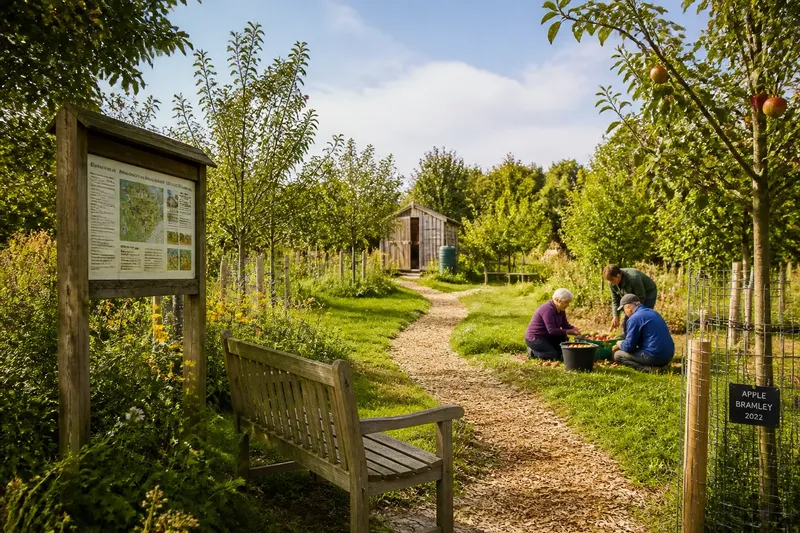
On a first visit to a community orchard, you might spot a muddy path, a row of young trees and a bench angled toward the field. Those details tell you more than a signboard alone: an orchard can be a working growing space, a shared responsibility and somewhere to pause. Look slowly, and you can get a feel for how those roles fit together without needing to know the local routine.
What makes a community orchard different from a private one?
A community orchard is cared for or used by people connected through a local group, organization or informal arrangement. The exact setup varies. Some welcome drop-in visitors; others are open only during gatherings or working sessions. The word “community” does not automatically mean every tree, fruit or tool is available for anyone to use.
Notice how the place signals its purpose. A map might mark public paths, a board might explain seasonal work, or a gate notice might give visiting hours. There may be fruit trees alongside seating, a wildlife corner, a small shed or an open patch used for events. These features can coexist, but each reflects choices about what the orchard is for.
Try to read the whole setting rather than judging it by how tidy it looks. Long grass beneath trees may shelter insects or make room for flowers; a cleared strip may keep a route accessible. A few fallen apples might be left for wildlife, compost or later collection. Care can look different from the neat rows of a commercial orchard.
How can you tell how the orchard is cared for?
Look for signs of ongoing attention, not a polished finish. Tree guards, support stakes, labeled varieties, mulched ground or a water container can suggest care at different stages. A compost area may show how prunings or spoiled fruit are handled. These clues are useful, but they do not tell the full story: the orchard may be between work sessions or adapting its routine to weather and available help.
Notice whether the trees seem to have different needs. Young saplings may be protected from browsing animals, while established trees have open space around their trunks. A path may be kept clear even where the surrounding grass is left high. Such contrasts can show how people balance access, habitat and fruit growing in a shared place.
There is no need to inspect equipment or handle plants to understand the rhythm of care. A posted calendar, a tool-cleaning station or a simple sign asking visitors to leave fallen fruit can explain more than guessing. Follow visible guidance, and ask before picking, pruning, feeding animals or moving anything.
What should you notice about the people who use it?
Notice how the orchard accommodates different kinds of visitors. Is there a clear route from the entrance? Can someone sit near the trees without standing in a work area? Are there signs that children, older visitors or people who move at a slower pace have been considered? A bench, a firm path or a quiet corner may make the place usable in ways that are easy to overlook.
Listen for the orchard’s social cues. People may be chatting while working, stopping briefly on a walk, or gathering around a shared task. None of these is the only proper way to use the space. A visitor can be welcome without joining in, and a busy group may be concentrating rather than inviting conversation.
If a volunteer is nearby, a small, specific question is often easiest to answer: “Is this path open to visitors?” or “Are fallen apples collected?” If they are occupied, a notice or another visit may be the better option. The orchard belongs to a local pattern of care, not to the person who happens to be standing closest to the gate.
How do you visit without disturbing the orchard?
Start by following the entrance signs and staying on marked paths. Keep dogs close where allowed, give working groups room, and avoid stepping over guards or into planted beds. If the ground is soft, the established route may protect roots and prevent the path from widening into wet grass.
Do not assume that fruit is free to take. Some orchards invite picking at particular times; others reserve harvest for group use, processing or wildlife. Ask first, and check whether a basket, tool or sign has a stated purpose. The same principle applies to flowers, branches and produce on the ground.
Say you arrive while a small group is sorting windfall apples beside a path. You could pause at a respectful distance, read the posted notice and ask whether visitors may pass or help. If the group needs the space, taking the other marked route would leave their work undisturbed; if they invite you to join, you can decide whether that suits your visit.
It is not worth the effort to identify every tree or decode every maintenance choice during a first visit. A few clear observations are enough to understand how the space works. Save detailed questions for a guided walk or a time when the orchard is less busy.
What are visitors most likely to wonder?
Can I pick fruit on my first visit?
Only if the orchard’s signs or a local organizer say picking is welcome. Fruit may be set aside for a shared harvest, wildlife or processing, so ask before taking any.
Should I bring gardening tools?
No, not for an ordinary visit. Tools can create confusion or risk if work is underway; join a scheduled session if you want to help, and follow the organizers’ directions there.
How long should I stay?
There is no expected length of visit. A brief walk can be enough to notice the paths, trees and signs, while a quiet bench may invite a longer pause if the space is open and unoccupied.
What if I find no one there?
Use the posted information and enjoy the public areas that are clearly open. A quiet orchard is not necessarily abandoned; seasonal work and visits may happen at particular times.
What does the orchard’s layout tell you?
Look at how the space joins its different uses. A path that passes trees without cutting through a work area can keep a casual visit separate from maintenance. A seat near, but not inside, a planting zone lets someone rest while leaving room for care. A noticeboard near the entrance may handle practical information without turning the orchard into an event venue.
Small design choices can also reveal whose needs have shaped the place. A gate that is easy to spot, a clear route and a readable sign help newcomers orient themselves. A shaded seat or an open view across the trees can make a short stop feel comfortable. These are not just decorative additions; they influence whether the orchard feels like a place to use or merely a place to look at.
On a first visit, notice what the orchard asks of you as well as what it offers: a little patience around shared work, care with paths, and respect for local rules. That is a useful way to read a community orchard—less as a collection of trees than as a place where growing, responsibility and rest have been arranged side by side.