The Parish Noticeboard as a Map of Local Life
The parish noticeboard makes local information visible and preserves traces of community memory, from handwritten notices to the changing shape of village life.
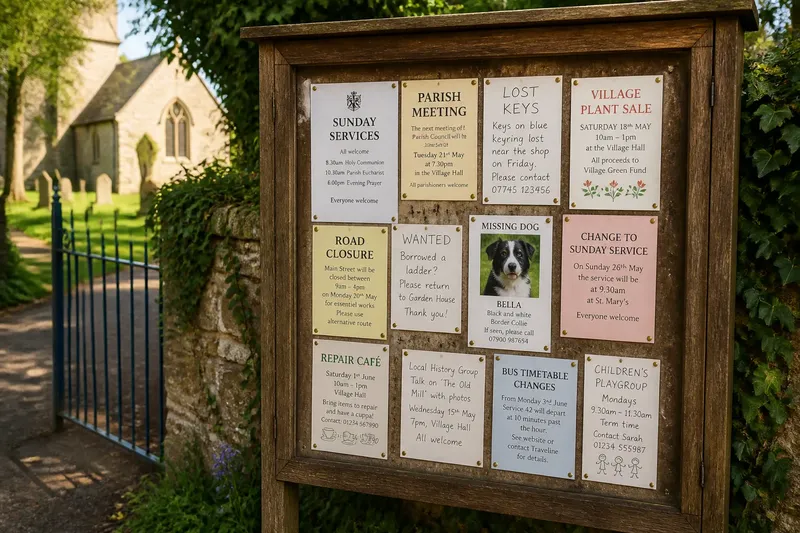
A parish noticeboard can tell you what is happening before you have spoken to anyone. A jumble of paper at the post office, church gate, shop entrance, or bus shelter may announce a lost key, a meeting, a sale, and a change to the Sunday service. The parish noticeboard is not merely a surface for announcements; it is a public record of what neighbors have needed to share.
Where does a noticeboard belong?
Its location is part of its message. A board beside a church door may carry services, parish meetings, and notices from local groups. One outside a village shop can reach people on routine errands. A board near a bus stop may serve residents who pass through on foot, including those who do not use social media or visit community buildings often.
Older boards frequently grew from the practical business of a local institution. A parish church, council, school, or shop had a doorway where people naturally paused, and a notice could be pinned where it would be seen. The arrangement was rarely grand. Its strength came from being close to ordinary movement: a gate opened, a queue formed, a familiar path crossed.
That placement also reveals who the board is meant to include. A notice hidden behind a locked gate or displayed only inside a building during limited hours has a narrower audience than one visible from a public path. When looking at a board, notice its sightline, lighting, shelter, and approach. A clear panel at eye level matters little if a hedge obscures it or the route is difficult to reach.
What did the board make public?
Before messages could be sent instantly to a household, a posted notice offered a shared point of reference. It could announce a vestry or parish meeting, a road closure, a collection, a lost animal, a change in service, or a local sale. These were not all the same kind of information. Some concerned public decisions; others relied on a neighbor seeing the paper and passing the word along.
The board’s authority depended on who maintained it. An official parish notice might carry a seal, signature, or formal wording. A hand-written note from a resident could be less formal but just as useful. Both occupied public space, yet readers could usually distinguish a statutory announcement from a request to return a borrowed ladder.
That distinction remains useful. A board can hold notices from institutions and residents without pretending that every message has equal status. Clear headings, a named contact, and a visible posting date help a reader judge what is current and who is responsible. The paper itself becomes part of the information: a printed letterhead suggests one source, while a penciled note asks for a different kind of attention.
How does paper become community memory?
A board is temporary by design. Notices are taken down when an event passes, a request is answered, or the paper becomes weathered. Yet people remember what appeared there: the appeal for a missing dog, the room change for a meeting, the announcement that a familiar service would pause. The board’s memory is made less of a complete archive than of repeated encounters.
Its traces can be found in small details. Layers of drawing pins mark where a notice has been replaced. A faded rectangle may show where a larger sheet protected the board from rain. Handwriting changes from one committee secretary to another. If old notices are preserved in a parish archive or local history collection, they can show which concerns came back year after year and which places served as shared meeting points.
Preservation needs judgment. Keeping every flyer would turn a useful board into a paper store, while discarding everything can erase the texture of local life. A modest record might retain a sample of recurring notices, a photograph of the board at intervals, or a small set of papers connected to a major local change. Permission and privacy matter, especially when a notice includes a private address, phone number, or personal appeal.
What does a changing board tell you?
The mix of notices shifts as the community changes. A school announcement may give way to a notice about transport, a new walking group, or a service operating from a different place. A board crowded with handwritten requests suggests a different rhythm from one dominated by polished leaflets. Neither arrangement tells the whole story, but each offers a glimpse of how people find one another.
Look for gaps as well as papers. A blank board may mean there is little to announce, or that notices have moved to a digital channel, or that the board is hard to access. A neat row of current, dated notices may show active care. A rain-stained cluster with expired dates may point to unclear responsibility rather than a lack of community interest.
Say a resident wants to promote a repair café but does not know who checks the board. They could look for a contact name on existing notices, ask the shopkeeper or parish office, and then submit a clear sheet with the event’s place, date, and contact details. The observable result to look for is straightforward: the notice appears in the agreed space and remains legible until the event has passed.
How can a board stay useful without losing its character?
A well-kept board does not need elaborate design. It needs a person or group who knows what belongs there, a way to remove out-of-date paper, and a simple means for residents to ask for space. A small set of practical habits can help:
- Check that the board can be reached and read from the public route.
- Give each notice a posting date or clear event date.
- Keep official announcements visually distinct from personal requests.
- Leave room for notices from residents, not only established organizations.
- Remove expired paper promptly, while setting aside items chosen for local archiving.
- Provide a contact method for people who cannot pin up a notice themselves.
What is not worth the effort? Requiring every resident to use one elaborate template or color code. A board should be legible, not fussy; a plain sheet with a clear heading can do its job. If there is a local rule about public notices or a board controlled by a particular institution, follow that arrangement rather than improvising a competing system.
What do people ask about parish noticeboards?
Who is allowed to put a notice on a parish noticeboard?
It depends on who owns or manages the board: a parish council, church, shop, or community group may set its own posting policy. Look for a contact name or ask the organization responsible before adding a notice.
How long should a notice stay up?
Keep it visible long enough for the intended audience to see it, then remove it when its information is no longer current. An event date or posting date helps the person tending the board make that decision.
Can a noticeboard replace online announcements?
It serves a different route to information. A physical board can reach people who pass a particular place, while an online post can travel beyond it; using both may suit a community that relies on neither channel alone.
Where can old parish notices be preserved?
Ask the parish office, local history group, church, or archive whether it keeps relevant papers or photographs. Preserve only material that can be shared appropriately, and remove personal contact details when they are not needed.
The parish noticeboard’s history is written in its ordinary use: who pins up a message, where they choose to place it, and which neighbors stop to read. To understand a parish noticeboard today, look not only at the words but at the route past the board and the people who keep it legible. That is where its public purpose and its local memory meet.