Why a Village Hall Can Hold More Than One Kind of Gathering
A village hall can welcome different groups without losing its character. Learn how to match shared rooms, simple expectations, and local habits to each gathering.
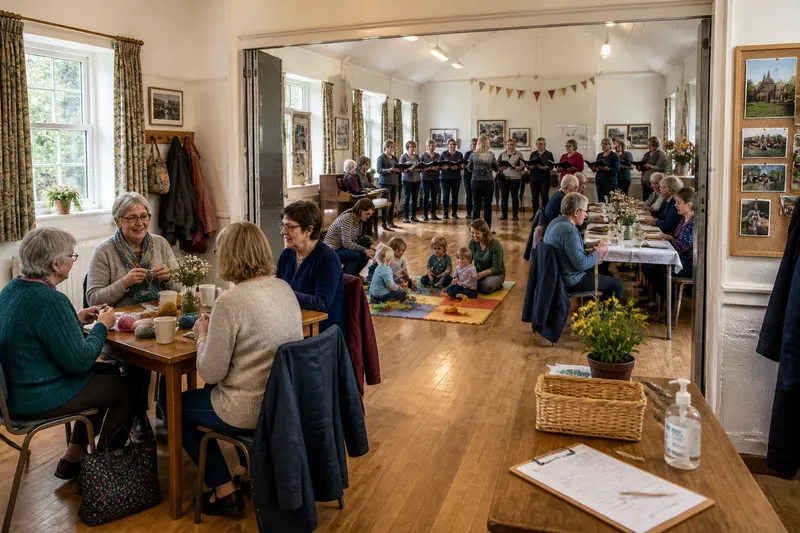
A village hall can host a toddler group on Monday, a choir rehearsal on Wednesday, and a family celebration on Saturday without feeling like three unrelated places. The trick is not to make every gathering behave alike. It is to match each group to the room, the shared expectations, and the signs of local ownership that help people feel welcome.
If you help manage a hall, or are choosing a space for a group, start with the kind of use in front of you. A quiet meeting, a messy craft session, and a large social evening ask different things of the same building. The right arrangement lets each gathering belong without making the next one harder.
What kind of gathering are you planning?
Sort the use by what people need to do, not just by the name of the group. A “club meeting” might involve a circle of chairs and careful conversation, while another might need tables, movement, and room for equipment.
- Conversation and decisions: Choose a layout where people can see one another, with a clear spot for papers and refreshments. A smaller side room may feel more inviting than a large hall with rows of empty chairs.
- Movement or practice: Keep the main floor open and decide where coats, bags, and equipment can go. The group needs room to move without turning entrances into obstacles.
- Children, crafts, or shared food: Look for washable surfaces, nearby handwashing, and a place to set out supplies. Agree in advance who will return the room to its usual condition.
- A public social gathering: Plan for arrival, seating, and quieter conversation as well as the central activity. A few small tables at the edge can give people a place to pause.
These are starting points, not permanent claims on a room. If a group’s needs change, revisit the arrangement rather than treating an old booking pattern as the only possible one.
Which room should carry the activity?
In a hall with more than one usable space, give the liveliest or most equipment-heavy activity the room that can handle its footprint. Save a snug or meeting room for work that benefits from a quieter setting. If the building has only one main room, define zones with furniture instead of trying to divide the room with makeshift barriers.
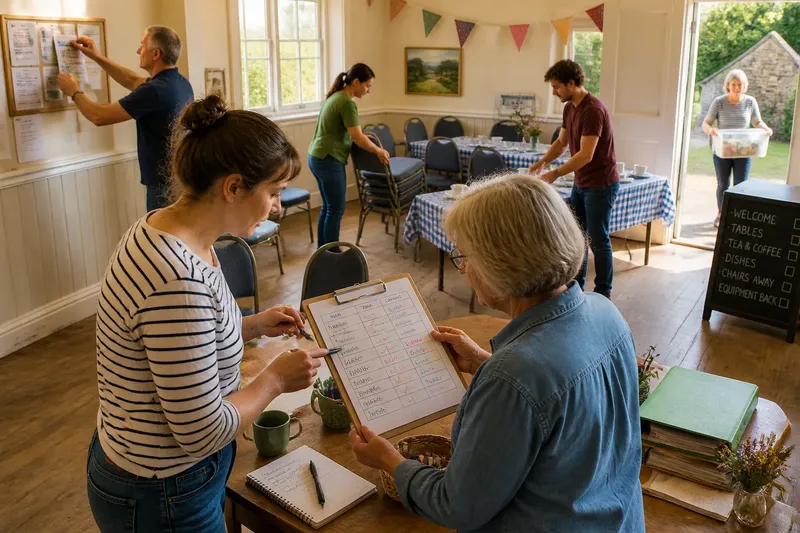
Pay attention to what happens at the edges. A welcome table near the entrance can prevent late arrivals from crossing the middle of a meeting. A coat rail away from the doorway can keep people from bunching up. Store chairs and folding tables where they can be reached without dragging them through another group’s activity.
Say a local knitting circle expects a dozen people, and a youth drama group needs the hall later that evening. Imagine the hall committee puts the knitting circle in a smaller room with a central table, then agrees that yarn bags stay beneath chairs and the table is cleared before departure. The expected result is a quieter conversation and a usable main floor ready for rehearsal, without asking either group to give up its purpose.
What expectations make sharing easier?
Clear expectations are most useful when they describe visible actions. “Leave the hall tidy” can mean different things to different people. A short room note can say where cups go, which furniture returns to storage, and whether the group should sweep up craft scraps.
Keep the shared rules limited to matters that affect the next user or the building: arrival and departure, access to storage, rubbish, noise, and the condition in which the room is handed back. For anything involving the building’s equipment, capacity, or local requirements, follow the venue’s instructions and applicable local rules.
Do not turn every small preference into a rule. It is rarely worth specifying the exact angle of each chair or insisting that every group decorate in the same style. Focus on what another user will actually notice: a blocked doorway, missing table, food left behind, or an unclear handover.
How can regular groups share ownership?
A room feels shared when people can see that its care does not belong to one permanent group alone. That does not mean every user must take on the same duties. It means the hall’s common spaces, furniture, and local character are treated as something each gathering can respect and contribute to.
Invite groups to suggest small, useful improvements: a labelled shelf for commonly used materials, a better place for a sign-in sheet, or a display that reflects more than one part of village life. Keep personal or group-specific items in agreed storage rather than letting them gradually occupy shared shelves.
Make changes with the people who use the room. A notice about a new layout is less helpful than a brief conversation about why it is changing and where things now belong. When a group has a different preference, ask whether it can be accommodated on its booking without making the room less usable for everyone else.
Which arrangement fits your situation?
What if the group meets every week?
Give regular users a predictable setup and a simple way to reset it. They can keep familiar materials in an agreed place, but should leave shared surfaces and routes clear for the next booking.
What if the gathering is occasional?
Use a concise room note or a named contact to explain access, furniture, and handover. Occasional visitors should not need local knowledge to find the basics or know what to do before leaving.
What if two groups need the hall on the same day?
Look first at whether one can use a separate room or a different layout, then consider whether the booking times allow a calm handover. If both uses need the same space at once, a clear boundary and agreed storage may help, but only if people can still enter and move around comfortably.
What if users disagree about how the room should look?
Separate practical needs from personal taste. Agree on a neutral everyday arrangement, then let each group make reversible changes for its own gathering and restore the shared setup afterward.
How do you keep the hall welcoming over time?
Notice patterns rather than relying on assumptions. If groups repeatedly move the same table, ask whether its usual position is getting in the way. If a room stays unused while the main hall feels crowded, find out whether the obstacle is poor signage, inconvenient storage, or simply that people do not know the smaller room is available.
Review the arrangements with a mix of users, including people who attend occasionally. Regulars may know where everything is; a newcomer can spot the unlabeled cupboard or confusing entrance that makes a first visit awkward. Keep what works, adjust what causes friction, and explain changes plainly.
A village hall can hold more than one kind of gathering because its identity comes from the people who share it, not from a single fixed layout. Match the room to the activity, make handovers understandable, and leave room for each group to add its own character. That is how a common building stays useful without becoming anyone’s private territory.